Cold Storage Forklift Guide: What Changes at -20°C
Cold Storage Forklift Guide: What Changes at -20°C
Operating a cold storage forklift is not the same as operating a lift in a standard warehouse. It is not even close. The physics change, the equipment wears differently, and the mistakes cost more. If you are buying or spec'ing a forklift for freezer or refrigerated environments, this guide covers what actually matters.
BC has significant cold storage demand. Salmon and seafood processing, berry packing, brewing, pharmaceutical distribution, and a growing frozen food logistics sector all require cold storage equipment that can perform reliably in environments most standard forklifts were never designed to handle. At Level Warehouse Equipment, we work with cold storage operators regularly, and the conversations always start in the same place: what changes when the temperature drops below freezing?
Everything.
Why Cold Storage Breaks Standard Forklifts
A standard forklift is engineered for environments between roughly 0°C and 40°C. Push it into a -20°C freezer and you are working against the machine's design in every system simultaneously.
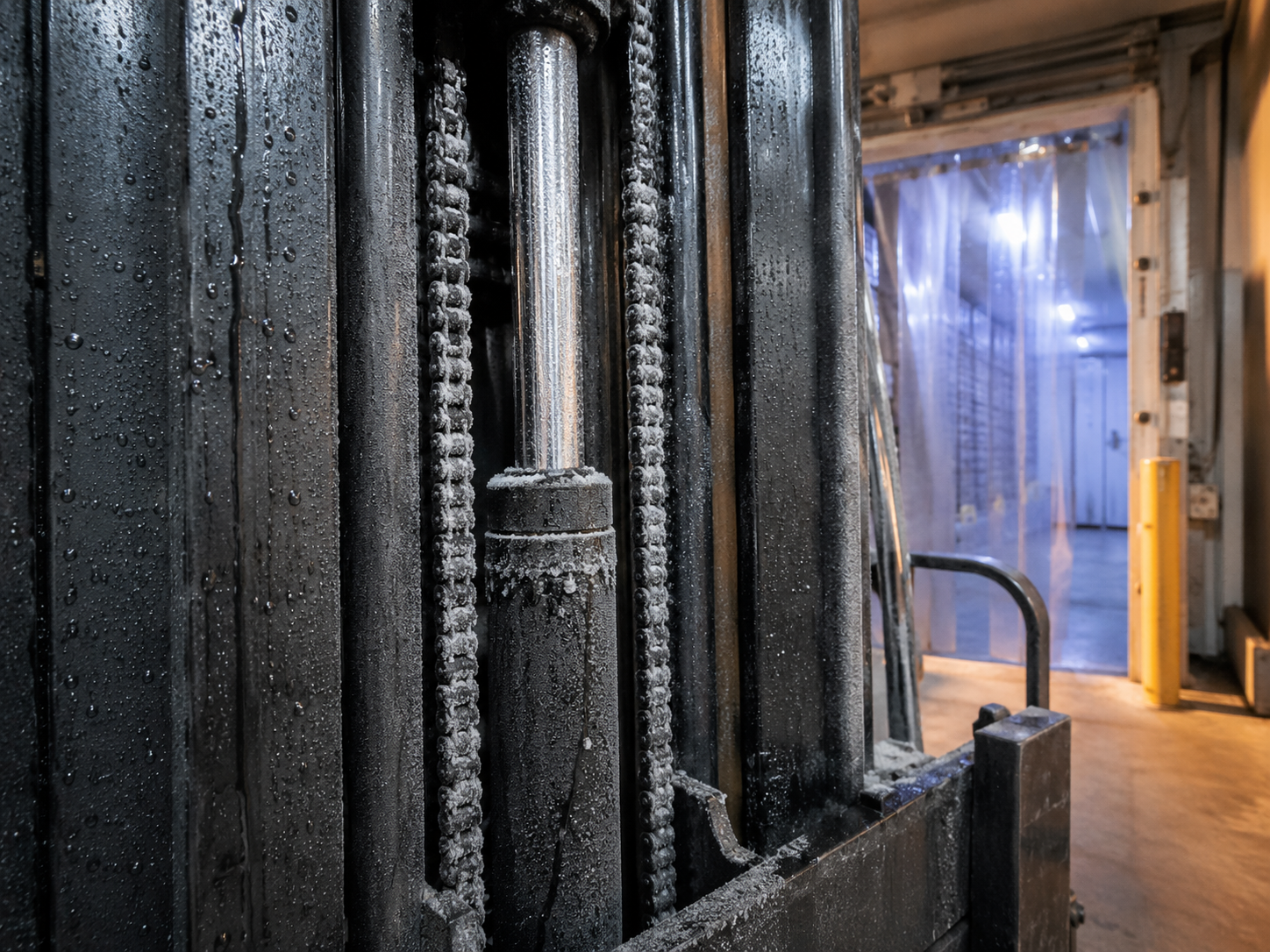
Hydraulic fluid thickens. Seals contract and lose their ability to hold pressure. Battery capacity drops. Grease stiffens in bearings and pivot points. Electronics become brittle. Condensation forms every time the unit cycles between the freezer and the dock. None of these problems show up on a spec sheet, and none of them announce themselves gradually. They compound, and when they fail, they fail during production.
A freezer forklift is not a luxury spec. It is an operational requirement. Running a standard unit in cold storage is not "making do," it is accelerating the machine toward an early and expensive failure.
Hydraulic Fluid: The First Thing to Change
This is the single cheapest upgrade and the most commonly missed. Standard hydraulic fluid is formulated for ambient temperatures. In a freezer environment, it becomes sluggish, which means the hydraulic pump has to work harder to push thicker fluid through the system. That extra strain shortens pump life, increases energy consumption, and makes the controls feel unresponsive.
Cold-rated hydraulic fluid maintains its viscosity at low temperatures. Swapping to the correct grade costs a few hundred dollars at most, and it protects thousands of dollars in hydraulic components. If you are buying a used forklift for cold storage, this is the first question to ask: has the hydraulic fluid been switched to a low-temperature grade? If the answer is no, or if nobody knows, budget for the swap immediately.
Battery and Power Source in the Cold
Electric forklifts lose 30 to 40% of effective battery runtime in freezer environments. That is not a rough estimate, it is the reality that cold storage operators deal with every shift. A battery rated for eight hours in a standard warehouse may only deliver five hours in a -20°C freezer.
This does not mean electric is the wrong choice for cold storage. In fact, many refrigerated warehouse forklift operations prefer electric because of the zero-emission advantage in enclosed, poorly ventilated freezer spaces. But the sizing must account for the capacity loss. If you are running electric in cold storage, you either need a larger battery, a second battery for swap-outs, or a lithium-ion pack that handles cold cycling better than lead-acid.
Propane units avoid the battery problem but introduce exhaust emissions in enclosed freezer spaces where ventilation is already limited. If you have read our guide on electric vs propane vs diesel forklifts, you know the tradeoffs. In cold storage, the ventilation constraint usually tips the decision toward electric, with the battery sized accordingly.
The Condensation Problem
This is the one that destroys equipment and most buyers never see coming.
Every time a freezer forklift cycles from the cold zone to the loading dock, the temperature difference causes condensation to form on every surface of the machine. Metal, wiring, circuit boards, connectors, the mast, the battery compartment, all of it. That moisture then freezes when the unit goes back into the cold. Repeat this cycle dozens of times per shift, and you are looking at corroded wiring, shorted electronics, seized bearings, and rust forming in places it has no business forming on a machine that is only a few years old.
Mitigating condensation requires a combination of approaches. Insulated battery compartments help protect the electrical system. Anti-condensation heaters on critical electronics keep components above the dew point during transitions. Sealed wiring harnesses and marine-grade connectors reduce moisture intrusion. And operational discipline matters too. Minimizing the number of transitions per shift and allowing brief equalization time when possible both reduce the condensation load.
If you are buying a used freezer forklift, check for signs of condensation damage. Corrosion on electrical connectors, rust on the mast channels, and water staining inside the battery compartment are all indicators that the previous operation either did not mitigate condensation properly or ran the unit harder than the cold storage equipment was designed to handle.
Operator Comfort and Safety
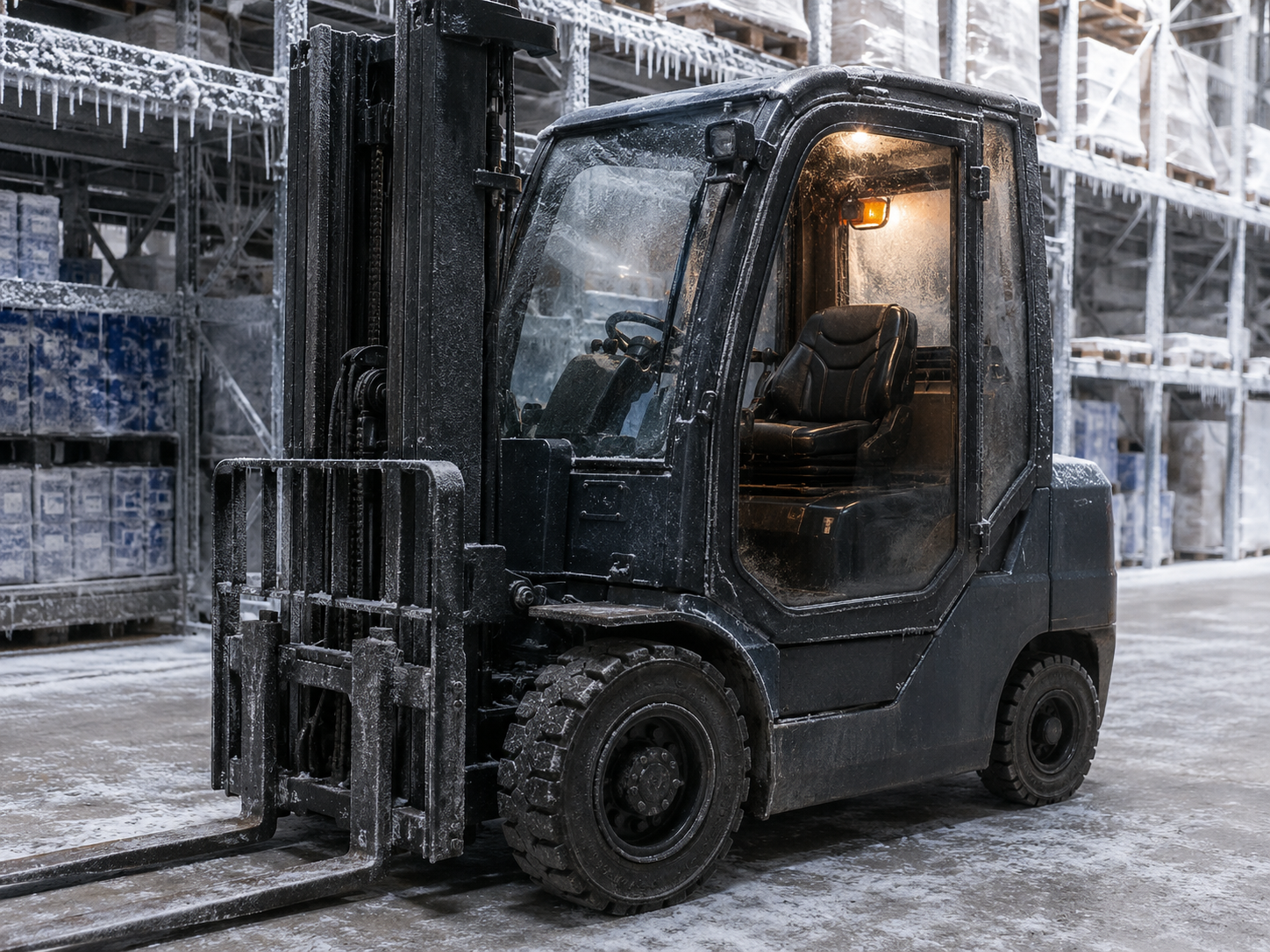
Cold storage is hard on operators. Eight hours in a -20°C environment, even with PPE, creates fatigue, reduces dexterity, and increases the likelihood of errors. Heated cabs, heated seats, and controls designed for gloved hands are not comfort features. They are productivity and retention tools.
A heated cab adds $3,000 to $8,000 depending on the unit and configuration. That sounds like a significant line item until you calculate the cost of operator turnover in cold storage roles, which is consistently higher than standard warehouse positions. Operators who are cold, uncomfortable, and fighting stiff controls make more mistakes and quit faster. The heated cab pays for itself in retention alone for most operations.
If you are running a cold storage operation and your current forklifts do not have heated cabs, it is worth evaluating the retrofit cost against your turnover numbers. The math usually speaks for itself.
What to Spec on a Cold Storage Forklift
Here is the short list of upgrades that turn a standard lift into a cold-rated freezer unit:
Cold-rated hydraulic fluid matched to your operating temperature range. Insulated battery compartment with anti-condensation heating elements. Sealed electrical connectors and wiring harnesses rated for moisture exposure. Heated operator cab with defrost capability for the windshield or guard. Controls sized for gloved operation. Cold-rated grease in all bearings, pivot points, and mast channels. Stainless steel or coated hardware in high-corrosion areas.
A used forklift can be retrofitted for cold storage, but verify the retrofit was done by a qualified shop, not field-improvised. A proper cold storage conversion follows the manufacturer's specifications for that model. A field improvisation with aftermarket heaters zip-tied to the battery box is not the same thing, and it will not hold up.
Can a Used Forklift Work in Cold Storage?
Absolutely, and many of the refrigerated warehouse forklift units we place are quality used machines with cold storage specifications already in place. The key is matching the machine's history to the application. A used unit that spent its previous life in a well-managed freezer operation with proper cold storage equipment spec is a strong buy. A used unit being converted from standard warehouse duty requires the full retrofit, and the cost of that retrofit needs to be factored into the purchase decision.
Frequently Asked Questions
Can a regular forklift work in a freezer? Technically it can operate, but it will fail faster, perform worse, and cost more to maintain than a properly spec'd unit. Standard hydraulic fluid, batteries, and electronics are not designed for sustained sub-zero operation. Running a standard forklift in cold storage is a short-term workaround, not a long-term solution.
What is the temperature limit for a standard forklift? Most manufacturers rate standard forklifts for operation above 0°C. Below that, you are outside the design envelope and the warranty likely does not cover cold-related failures. Anything below -10°C absolutely requires cold-rated specifications.
Are electric or propane forklifts better for cold storage? Electric is preferred in most cold storage applications because of zero emissions in enclosed, low-ventilation freezer spaces. The tradeoff is battery capacity loss in the cold, which must be sized for. Propane can work in cold storage with adequate ventilation, but the ventilation requirement is harder to meet in sealed freezer environments.
How much does a cold storage forklift cost vs. a standard one? Expect a 15 to 25% premium over a comparable standard unit for a factory cold-rated forklift. Retrofitting a standard used unit typically runs $5,000 to $12,000 depending on the scope. The premium pays for itself in reduced maintenance and longer equipment life.
Do forklifts in cold storage require special maintenance? Yes. More frequent hydraulic fluid checks, battery inspections, electrical connector inspections for corrosion, and grease intervals shortened by roughly 30% compared to standard environments. The maintenance schedule for cold storage equipment should be adjusted from day one, not after the first failure.
The Cold Storage Bottom Line
A cold storage forklift is not a standard forklift with a heater bolted on. It is a machine configured for a specific environment where the physics work against every system simultaneously. Get the spec right and the machine will perform reliably for years. Get it wrong and you will spend more on repairs, downtime, and operator turnover than the proper spec would have cost in the first place.
At Level Warehouse Equipment, we help cold storage operators in BC find the right machine for the environment, whether that is a factory cold-rated unit or a quality used forklift with a proper retrofit. If you are buying for cold storage and you are not sure what to spec, give us a call. We will walk through the application with you before anything else.
Back to Resources